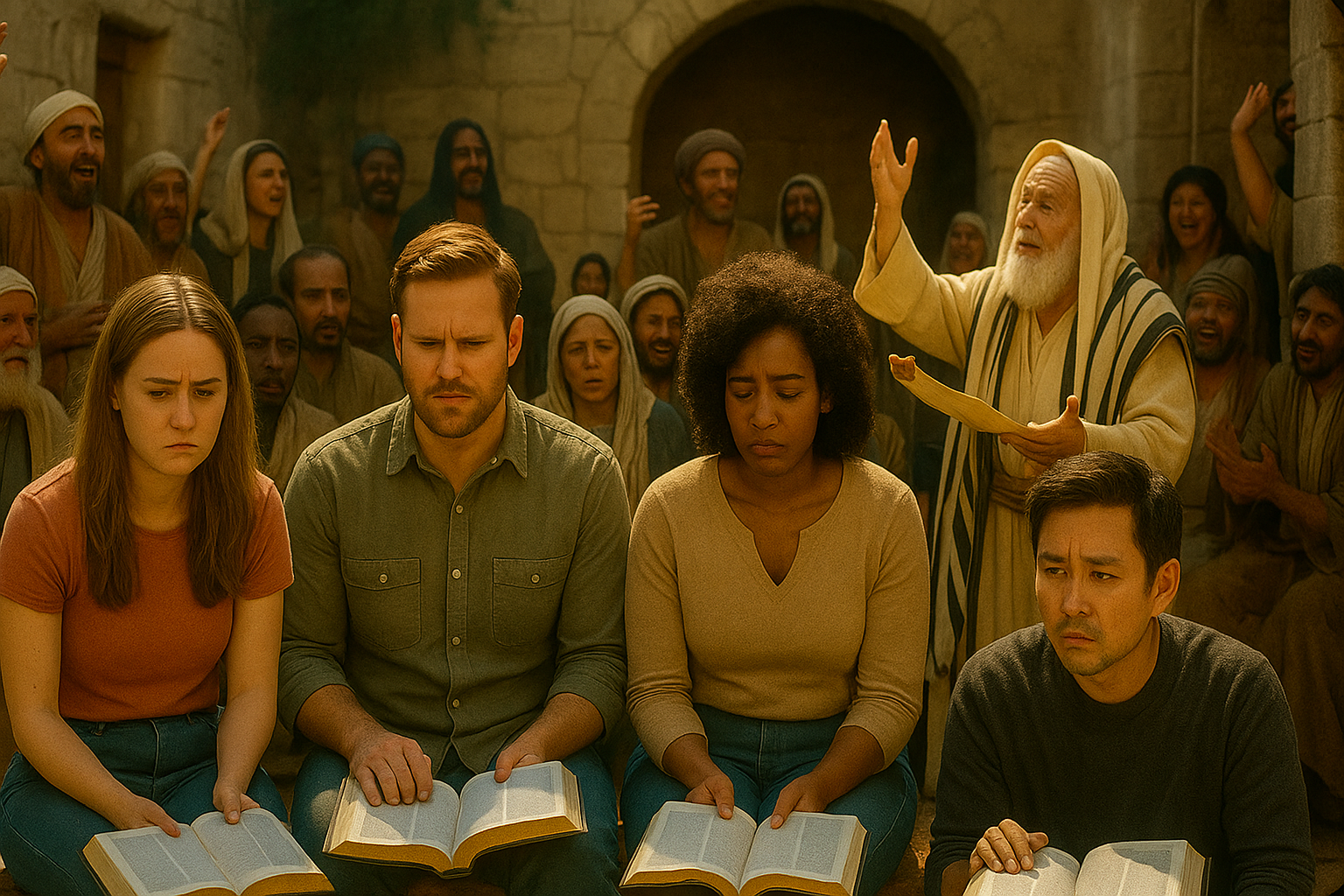
The Problem with Losing Context
When the Bible is read without its Jewish context, it risks sounding tame, sentimental, or abstract. Stripped of the world of covenants, festivals, rabbinic idioms, and everyday Jewish life, the text can feel distant and thin. In the West, when we talk about context, we usually mean reading a verse within the paragraph, the paragraph within the chapter, and the chapter within the book. But this can result in stacking abstract context on top of abstract context, without ever stepping into the lived world that shaped the words. Western translations often flatten Hebrew idioms, parables, and word pictures into plain statements, losing their edge. What was once sharp, disruptive, and life-altering in Jesus’ Jewish world can sound reduced—like a sword dulled into a spoon. The Jewish context is not an accessory; it is the very lens that makes the words of Scripture vivid, radical, and life-giving.
Western Misunderstanding: Faith as Private Morality
Modern Western readers live in a guilt–innocence culture. Right and wrong are seen as breaking rules or following conscience. The Bible is often treated as a personal guidebook for morality or inner spirituality.
But Jesus lived and taught in an honor–shame, covenant-centered world. Every parable, every teaching, carried echoes of Torah, Temple, land, festivals, and rabbinic debate. To strip away that context is to mute His voice.
Scripture in Focus
Take Matthew 5:29:
“If your right eye causes you to stumble, gouge it out and throw it away.”
Read literally in the West, this sounds grotesque. Read sentimentally, it becomes a vague warning: “Try not to sin.” In the Western mindset, the focus is on personal morality—avoid doing wrong.
But in Jewish teaching, hyperbole was a standard rhetorical device. Rabbis spoke this way to shock listeners into remembering a point. The aim was not merely to warn against sin but to press home the uncompromising urgency of holiness. Jesus’ Jewish audience did not reach for spoons to gouge their eyes—they understood that nothing, not even the most precious part of life, should stand in the way of covenant faithfulness. The Jewish context transforms the meaning from a generic call to “avoid sin” into a radical demand for loyalty to God above all else.
Historical Context: Jesus’ World of Layers
Jesus taught in a world shaped by Scripture, synagogue, and the rhythms of festivals. His listeners carried the Psalms in memory, the Torah in prayer, and rabbinic idioms in conversation. They heard Him with multiple layers of meaning at once—Scripture, tradition, idioms, and lived practice—while we often hear only one flat layer at a time.
-
Temple practices informed His language of sacrifice and forgiveness. Daily offerings, atonement rituals, and priestly duties made terms like “lamb of God” or “forgive” rich with meaning. His hearers understood sacrifice not as an abstract idea but as a lived rhythm of worship and cleansing.
-
Agricultural life gave teeth to parables of sowers, vineyards, and shepherds. Everyone depended on fields, flocks, and weather. When He spoke of seeds falling on different soils or vines bearing fruit, the images carried the weight of survival and daily labor, not just symbolic lessons.
-
Rabbinic debate gave shape to His use of remez—dropping a phrase that pointed to a whole passage. Listeners trained in synagogue life could catch the allusion and recall the wider text. His words were not isolated sayings but woven into the fabric of Scripture and ongoing conversations about how to live Torah.
Without that world, His words can sound like loose metaphors instead of anchored truths. Without keeping their world and way of life in mind—putting ourselves in their shoes—we risk misreading Scripture as abstract lessons instead of concrete calls rooted in covenant, community, and daily practice.
Cultural & Rabbinic Insights
Rabbinic literature is filled with idioms that only make sense in that world:
- “A good eye” meant generosity; “an evil eye” meant greed. In the West, we often assume “a good eye” means looking at things positively or avoiding obscene sights. But in Jewish idiom, it was never about vision or entertainment choices—it was about posture toward others. A person with a good eye shared freely, saw the needs of the community, and gave without envy. An evil eye was stingy, guarded, and resentful, always worried about losing status or resources. This difference shows how Jewish context radically shifts the meaning of the phrase.
- “Binding and loosing” referred to halakhic rulings—decisions on how to live Torah. In the West, we often shout in prayer, “I bind…” or “I loose…,” imagining it as exercising spiritual power over demons or circumstances. But in Jesus’ Jewish world, it meant something different: granting or restricting permission in daily practice of Torah. A rabbi could declare an activity permitted (loose) or forbidden (bind). When Jesus gave His disciples authority to bind and loose, He entrusted them with teaching and applying God’s instructions, not magical formulas for spiritual warfare.
- “Yoke” meant a rabbi’s teaching, not farm equipment. In the West, many imagine Jesus carrying all the weight of life’s burdens and inviting us to yoke ourselves with Him so the load feels lighter. But in the Jewish setting, a yoke was the teaching and way of life a rabbi offered. To take on a rabbi’s yoke meant accepting his interpretation of Torah as your guide. When Jesus said His yoke is easy, He was contrasting His life-giving teaching with the heavy, complicated rulings of other teachers. The focus was not on splitting physical weight but on choosing which teaching would shape your entire walk of life.
When Jesus says, “My yoke is easy” (Matt 11:30), He is not talking about plowing. He is offering a way of life, a Torah-path, that brings rest instead of crushing burden.
Hebrew for “hear.” But in Hebrew thought, to hear is to obey. Losing that link reduces discipleship to passive listening instead of active faith.
Linguistic & Literary Insights
The Bible is full of Hebrew word pictures:
- Ruach – wind, spirit, breath. One word, three images. In Hebrew thought, ruach carried the sense of God’s invisible power: like wind it moves unseen, like breath it gives life, and like spirit it marks His active presence. Western translations often reduce it to one idea, but the word held all three at once, making passages about the Spirit far richer.
- Nephesh – not “soul” in the Greek sense, but the whole embodied life. In the Jewish worldview, a human was not divided into body and soul; nephesh described a breathing person in totality—flesh, blood, and spirit together. When the Psalms say “Bless the Lord, O my nephesh,” it means the whole self, not just inner thoughts.
- Shalom – not peace as quiet feelings, but wholeness, flourishing, covenant harmony. Shalom described communities living in right relationship with God, neighbor, and land. It meant security, justice, and joy woven together. To greet someone with shalom was to wish them covenant well-being in every dimension of life.
Without their depth, translations often flatten meanings. In the West, we tend to focus on facts, information, and analysis, but for Jewish readers the aim was to remain aware of God’s presence and make it as tangible and real as possible. Jesus’ words were heard as invitations to encounter God in daily life, not as abstract lessons. Without that context, His teachings become abstractions instead of living realities.
Scriptural Parallels
The Jewish context ties the Bible together:
- Exodus manna → John 6: Bread as covenant provision. When Jesus calls Himself the bread of life, He is echoing the wilderness manna—daily, God-given sustenance that proved His covenant faithfulness. The crowd would not have thought of abstract bread, but of their ancestors’ survival and dependence on God.
- Isaiah’s vineyard → Jesus’ parable of tenants: Prophetic critique reborn in story. Isaiah spoke of Israel as God’s vineyard that failed to yield good fruit. Jesus retells it in parable form, confronting leaders who misused God’s vineyard and pointing to Himself as the rejected son.
- Daniel’s Son of Man → Jesus’ claim in trial: Messianic identity rooted in apocalyptic vision. In Daniel 7, the Son of Man is given authority and everlasting dominion. When Jesus applies this title to Himself before the high priest, His listeners would hear not humility but a claim to ultimate honor and power—a direct challenge to their authority.
Theological Depth: Western vs Jewish Lens
- Western lens: Bible as private comfort, moral rules, or future hope. Faith is treated largely as individual, inward, and abstract.
- Jewish lens: Bible as covenant story, lived reality, present kingdom. Faith was public, communal, and embodied in daily life.
Jesus was not giving abstract wisdom. He was re‑anchoring His disciples in the covenant story of Israel, calling them into a new way of being God’s people together. This meant living God’s reign in tangible, daily practices—mercy, generosity, prayer, and justice—that displayed His kingdom here and now.
Big Idea
Reflection
- Where have you read Jesus’ words as private comfort instead of kingdom revolution?
- What idioms or word pictures have you misunderstood until you explored their Jewish roots?
- How might your discipleship change if you heard Him as His first disciples did—hearing with covenant imagination, shaped by festivals, Torah, and the honor–shame world He spoke into?
- In what ways could stepping into the Jewish context of Scripture move your faith from abstract lessons to concrete practices of mercy, generosity, and loyalty to God?
✨ SHEMA Lesson: Hear • Believe • Obey
- Hear: Open Scripture with attentive ears. Don’t just skim the words—receive them as the living voice of God speaking into your life.
- Believe: Trust that what God says is true, even when it confronts or stretches you. His promises and commands are not abstract—they are certain and trustworthy.
- Obey: Put His Word into practice. Do what He asks, even in small things, so that your life becomes a visible testimony of His reign.
Keep Walking
- Want to learn more? Explore our blog page to deepen your understanding of the Bible in its original context.
- Discover how the SHEMA Bible App helps you trace word pictures, remez, and hidden threads across Scripture. Join the waitlist