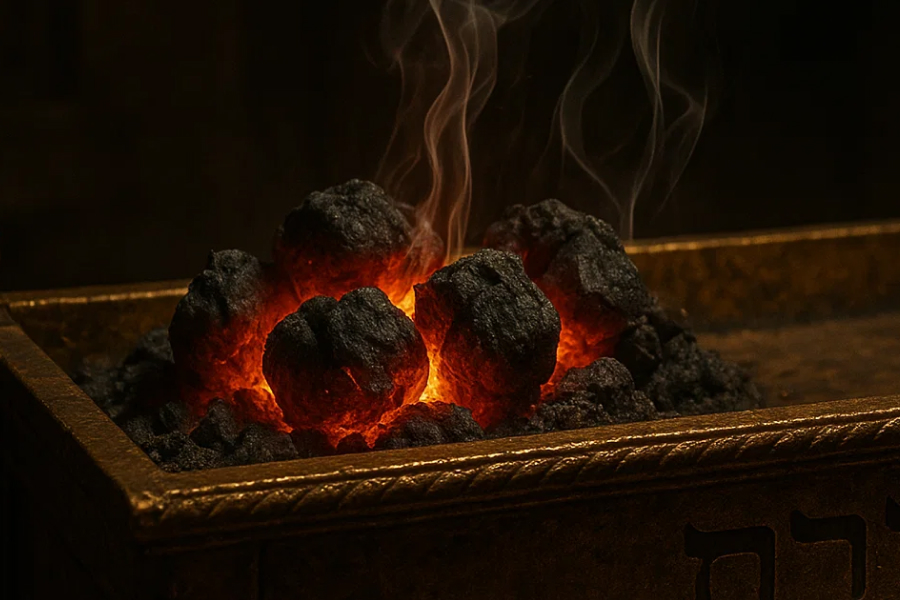
Burning Coals in the Bible: From Isaiah’s Altar to Paul’s Teaching
When many modern readers come across the phrase “heap burning coals on his head” in Romans 12:20, it can sound like a clever tactic: show kindness so your enemy feels guilty. Mercy used as subtle revenge.
But in the Jewish world of Paul’s day, steeped in Scripture and Temple life, “burning coals” carried a much deeper meaning. Coals were about God’s presence, purification, and renewal—not humiliation.
A Common Reading vs. the Biblical Lens
In much of Western culture, we’re trained to think in terms of the individual—personal feelings, private conscience, inner guilt. So it makes sense that when we hear Paul’s words we might imagine a personal, almost psychological outcome: “If I’m kind, my enemy will feel ashamed.”
In Israel’s world, though, the phrase stirred a different set of associations. For them, fire meant God’s altar, God’s cleansing, God’s refining presence. When Paul quotes Proverbs 25:21–22, he’s using a remez—a hint that pulls the whole story into view.
Historical Context: Fire in Israel’s World
Fire was never background in Israel’s life. It was central.
- Altar fire (Leviticus 6:12–13) burned continually as a sign of God’s ongoing presence.
- Festivals like Sukkot and Hanukkah involved light and fire as joy and dedication.
- Sinai shook with fire when God gave Torah (Exodus 19:18).
In Israel’s world, fire meant the Holy One had drawn close, it marked God’s presence. To live as His people was to picture holy fire—burning, refining, guiding—always close at hand.
Scripture in Focus: Coals Across the Bible
Isaiah’s Cleansing Vision
Isaiah 6:6–7 “Then one of the seraphim flew to me with a live coal… With it he touched my mouth and said, ‘Your guilt is taken away and your sin atoned for.’”
Isaiah is not shamed. He is purified. The coal prepares him for mission.
The Day of Atonement
Leviticus 16:12–13 “He shall take a censer full of burning coals from the altar before the LORD… and the cloud of the incense shall cover the mercy seat.”
On Yom Kippur, the high priest could not enter without coals. They created a meeting place for holiness and humanity.
Ezekiel’s Vision of Fire
Ezekiel 10:2 “Fill your hands with burning coals from among the cherubim and scatter them over the city.”
Here coals bring judgment, but judgment clears corruption so renewal can come.
David’s Song of Deliverance
Psalm 18:8,13 “Smoke rose from His nostrils… consuming fire came from His mouth; glowing coals blazed forth from Him.”
For David, coals were shorthand for God’s power breaking into history.
Cultural & Rabbinic Context: Fire as Presence and Torah
Jewish writings reinforced this imagery:
- Song of Songs Rabbah 8:6 – “Love is the flame of the LORD, coals of fire.”
- Pirkei Avot 2:10 – “Warm yourself by the fire of the sages.”
Hebrew root meaning flame or burning, often used for God’s presence.
Glowing embers used for sacrifice, purification, and warmth. They carried holiness.
To Jewish disciples, fire meant wisdom, love, and presence.
Jesus and the Charcoal Fire in John
John’s Gospel records two moments around a charcoal fire (anthrakia in Greek, literally “a bed of burning coals”). Many translations simply say “fire,” but this picture-word is important. Charcoal has weight—it carries smell, memory, and symbolism.
- Denial – Peter warmed himself at a charcoal fire when he denied Jesus (John 18:18).
- Restoration – After the resurrection, Jesus welcomed Peter at a charcoal fire with bread and fish (John 21:9).
The parallel is intentional. At the first fire, Peter’s failure burned. At the second, grace burned brighter. The coal became God’s altar of restoration.
Paul’s Teaching: Mercy as Priestly Action
Paul’s instruction in Romans 12:20 is not about clever revenge. It is about disciples acting like priests, carrying God’s altar fire into broken relationships.
To feed an enemy is to place a coal of God’s presence into conflict. Mercy becomes sacrificial, opening space for God’s refining work in both parties.
Romans 12:21 “Do not be overcome by evil, but overcome evil with good.”
Theological Contrast: Western vs Jewish Lens
Modern Western lens (individual focus):
Coals can sound like a metaphor for stirring someone’s guilty conscience.
Jewish lens (communal & scriptural focus):
Coals evoke the altar and God’s presence—mercy that purifies, not revenge that humiliates.
Big Idea
Reflection
- Who feels like an enemy in your life?
- What would it look like to place a coal of mercy in that relationship?
- Could kindness become the altar where God’s fire refines both of you?
✨ SHEMA Lesson: Hear • Believe • Obey
- Hear: Paul quotes Proverbs to call disciples into priestly action, not revenge.
- Believe: God’s presence through mercy purifies more than retaliation ever could.
- Obey: Carry the coal. Offer bread, water, or service to those who hurt you.
Keep Walking
- Want to learn more? Explore our blog page to deepen your understanding of the Bible in its original context.
- Discover how the SHEMA Bible App helps you trace word pictures, remez, and hidden threads across Scripture. Join the waitlist